I read Lee Jin-woo’s Meeting Economics Again (Korean title 나의 두 번째 교과서 X 이진우의 다시 만난 경제, Page2Books). The full title is longer than it needs to be. The useful half is the first: a second textbook. School economics taught production, consumption, supply and demand, and the duties of a responsible citizen. Adult life is full of other questions. Why does household credit rising by five trillion won not automatically mean the country is about to collapse? Why can a bond pay a fixed coupon and still lose value when rates go up? Why does “save more” fail as a complete theory of getting richer?
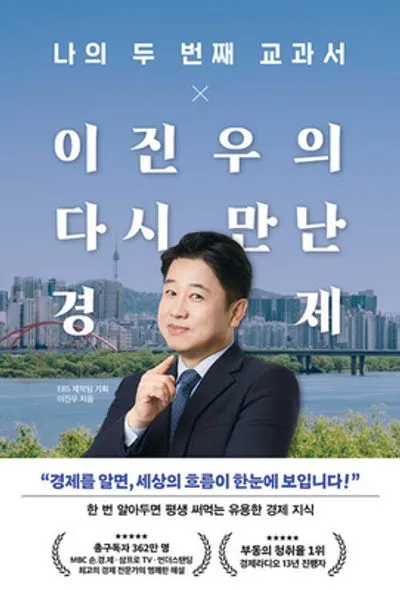
Lee is a former financial journalist who has spent years explaining the news on MBC radio and on channels such as SamproTV and Understanding. The book grows out of an EBS series. That pedigree shows. The writing is spoken, analogical, and impatient with the high-school table of contents. It is an explainer, not a treatise. That is useful to know before you open it. You will not get a model you can estimate. You will get a map of the financial system an adult actually walks through: money, risk, rates, apartments, debt, crises, growth, and choice.
Table of contents
Open Table of contents
What the book actually argues
In one sentence: the economy you live in is a financial economy, and its basic material is debt.
Lee’s opening move is to separate two skills that Korean common sense keeps gluing together. Saving money and multiplying money are not the same work. Thrift is still necessary. Thrift is not sufficient. A nineteenth-century picture of the economy — goods, factories, households putting coins in a drawer — will not explain a world where private banks, the government, the central bank, and foreign money act as taps, and where most of the money in existence is someone else’s liability.
From there the book is a sequence of translations. Household loan growth is also money creation. A deposit at the bank is an asset to you and a debt to the bank. Cash itself is a promise. Interest is the price of swapping money now for money later. A Korean apartment is not just cement. A crisis is not whatever the headline is shouting; it is the moment people stop trusting banks to be banks. A rich country is not rich because it found one secret. It found ways to turn inconvenience, credit, and human incentive into more output.
The last chapter is the least “economic” and the most adult. Choice, Lee says, is a bad game if you treat it as the hunt for the best option in advance. You cannot reliably pick the better future. You can refuse to ignore a constraint, choose, and then work so that the result becomes good enough. That is not a trading tip. It is a way of living inside uncertainty without turning every decision into a prayer.
The misconceptions it breaks first
More debt is always a disaster. Saving is how you get rich. High risk means high return, so the brave are paid. A financial crisis is whatever is loud on the news. Lee doubts all four.
The first is the one that makes Korean news hardest to read. If last month’s household loans rose, the reflex is doom: people are drowning, they will stop buying homes, prices will fall. Lee asks you to hold a second sentence next to that reflex. Those loans are also new money in the system. In the short run that can support prices, even as the long-run burden grows. Both can be true. The error is using only the moral word “debt” and never the mechanical word “liquidity.”
The second is the family proverb. Spend less, and the rest will follow. Lee does not mock thrift. He says it cannot do the job assigned to it. In a financial economy, the gap between people who only store money and people who can put money where it compounds is not a matter of virtue. It is a matter of seeing how money is made, priced, and moved.
The third is a slogan that sounds like physics. High risk, high return. Lee treats return as something that often arrives through time and through not being forced to sell, not through the thrill of a volatile bet. Volatility can make you rich or wipe you out. The difference is frequently whether you can sit still while the price looks stupid.
The fourth is theatrical. A crisis, in this book, begins when the bank is doubted — when credit stops circulating because nobody wants to be the one still lending. The size of the headline is a poor instrument. The 2008 story he retells is not “Americans were greedy.” It is a chain: good intentions, products nobody could locate, simultaneous defaults, mutual suspicion, a run. Korea’s late-1990s shock is told the same way, through exchange rates and borrowed dollars, not through a morality play.
The map, in ordinary language
The book is eight parts. You do not need to memorize the labels. Think of them as the holes that adult economic talk keeps falling into.
1. Money has to keep growing. Three taps add it: private banks, when they lend; the government and the Bank of Korea; and foreigners. If the stock of money stops expanding, the first people hurt are not theorists. They are households and firms that still have to pay yesterday’s debts in a thinner present.
2. Risk is not a personality test. Stocks and apartments do not move for the same reasons. People fail on a cycle they recognize too late: they enter when it feels safe and exit when it feels unbearable. Waiting is not passivity here. It is the only way a volatile claim can finish paying you.
3. Rates, bonds, and the exchange rate are one conversation. A bond is born with its coupon already printed. When market rates rise, that old paper is worth less. That is not a trick. It is the price of yesterday’s deal in today’s market. The exchange rate is the same idea across borders. If it never moved, something else in the system would have to absorb the pressure.
4. The Korean apartment is a special machine. Government-led supply, weak developers, and rows of identical buildings are not accidents of taste. Lee wants the reader to hear property news as a story about land, credit, exports, and rates, not as a soap opera about “the myth of the unsinkable apartment.” Cement is cheap. The right to live in a tight, credit-soaked market is not.
5. Debt is the engine, not a stain you can wash off. Someone must keep borrowing if the system is to keep adding money. That does not make every personal loan wise. It does mean “eliminate all debt” is not a description of a modern economy. Coffee is optional. This kind of debt is not. The useful question is which debts buy future time you can actually service, and which ones you cannot sit with when the price swings.
6. A crisis is a run on trust. Watch whether banks are still believed. Reserve ratios and capital ratios exist because the structure is permanently a little suspicious: banks owe money that can be demanded faster than their loans come back. The first good intention in a boom is rarely the last scene.
7. Rich countries are not a recipe you can photocopy. Britain’s steam, credit, and awkward geography are a case, not a template. Korea’s growth sat on a particular historical window. There is no single secret, and there is no guarantee the next fifty years repeat the last fifty. People, incentives, and the will to run a business keep returning as the unfashionable remainder.
8. The choice is after the choice. You will not reliably select the better life in advance. Check that you have not ignored a constraint. Then pick, and spend your effort making that pick work. Opening the brokerage app every hour is often the opposite of that discipline. The game rewards sitting still more often than it rewards a clever first move.
Why an adult should read this
School economics was designed for citizenship. There was a tidy diagram and a correct term for the exam. Adult economics arrives as a push notification: rates, the won, household credit, a sudden “crisis” that may or may not be one. Without a second textbook, those items stay as moods. Anxiety, greed, and the urge to do something.
Lee’s book is useful because it replaces the mood with a small set of mechanical pictures. Money has taps. A loan is new cash and a future burden at once. A bond is a frozen rate walking through a moving market. An apartment price is not a referendum on national character. A crisis is banks being doubted. None of that tells you what to buy next week. It tells you what a sentence on the evening news is actually doing.
Read it as a primer for reading, not as a substitute for accounting, a spreadsheet, or the patience the risk chapters keep demanding. The analogies are the method and also the limit. They get you into the room. They will not do the sitting for you.
What remains after reading
The remaining idea is smaller than “understand the economy.” It is this: most of the money you see is a promise, and most of the news you fear is a story about whether those promises still circulate.
The next action does not require a new identity as an investor. Take one item from this week’s news — household loans, the policy rate, the won, a housing headline — and force it through one of Lee’s pictures. Is this new money, a frozen old deal, a price of time, a run on trust, or just noise? If you can name which, the second textbook has started to work. Not when you finished the last page, but when the next headline became a sentence you could parse.