I read John Krumboltz and Ryan Babineaux’s Fail Fast, Fail Often (Korean title 빠르게 실패하기, Snowfox Books; a later printing adds a 더). The slogan sounds like Silicon Valley wallpaper. The book itself is smaller and more stubborn than that. After talking with tens of thousands of people in their project, the authors say they found one pattern that kept repeating. Happy and successful people spend less time planning and more time acting. They go out, try something new, and through the mistakes that follow they pick up experiences and chances no schedule had listed.
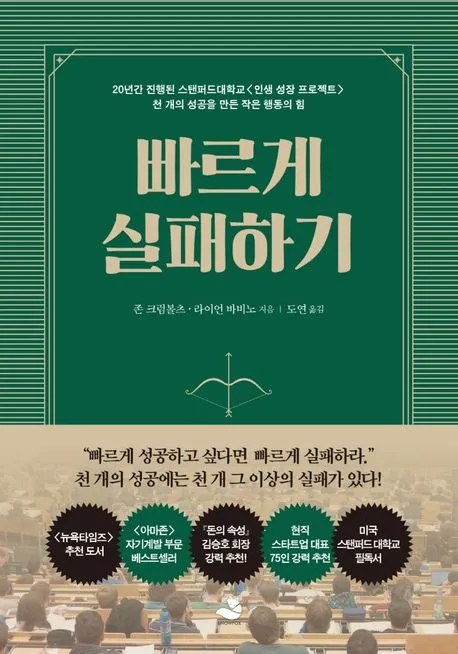
Krumboltz is a Stanford counseling psychologist, better known in the trade for happenstance learning theory — the claim that a career is not chosen so much as grown, by curiosity, flexibility, and a willingness to be interrupted. Babineaux taught the popular Stanford continuing-studies course that shares the book’s English title. The Korean jacket leans on a twenty-year “life growth project” and a stack of awards. Treat that as jacket copy. What you actually get is a short popular manual, and one instruction that will not go away. Do the small thing now. Leave yourself a next move. Let the result teach you what the plan could not see.
It is a how-to, not a treatise. That is useful to know before you open it. You will not get a model of decision theory. You will get a way of living inside uncertainty without turning every Tuesday into a planning meeting.
Table of contents
Open Table of contents
What the book actually argues
In one sentence: act so that more options stay on the table.
That is their rule of thumb for “fail fast.” It is not a dare to crash. It is a way of moving that keeps the future open. A curious beginner, they say, is already in the right state: able to learn, able to grow, able to notice the chance that only appears after you have started. The fear of looking like that beginner is what closes the table.
“Fail faster to learn faster” is the same idea Silicon Valley later sold as failing forward. Ship the thing soon enough that the world can answer. Read the answer as opportunity or as weakness. Then decide the next step. A product, a job, a hobby, a conversation — the object changes. The loop does not. You cannot get that feedback from a better outline.
They know the destination is not mysterious. Success and happiness arrive when you take the chance in front of you. The hard part is the taking. Can I really do this? Can I finish it? Can I stand the difficulty? Can I stand the change? Those sentences feel like prudence. The book treats them as the sound resistance makes when it wants you to stay seated.
The misconceptions it breaks first
You should plan first and start tomorrow. A careful list of gains and losses will tell you whether to move. You need a personality type and a career before you may begin. Failure is a verdict on you. The book doubts all four.
The first is the most familiar trick resistance uses. Most people, they write, are already skilled at delay. The work is important. The new thing is interesting. So you make a plan. The plan itself feels like progress. You feel better. You give yourself the day off. Tomorrow will be the real start. Tomorrow inherits the same ritual. The authors name this plainly: procrastination is resistance in its friendliest clothes.
The second sounds like intelligence. Weigh the pluses, weigh the minuses, then decide. The problem is the scale. People are better at spotting risk than at spotting a chance. They put a higher premium on the loss than on the gain, and they flinch harder at a negative cue. That is why no is so easy to invent and yes is so hard to justify. A pros-and-cons sheet is often just negativity bias with a table drawn around it.
The third is the career-counseling superstition. Find your type. Choose the path. Commit. The authors flip the claim. You do not need a personality label or a pre-decided career in order to live well. The excess plan and the unnecessary vow are often what get in the way. People are full of more than one character. Interests move. What lit you up this year may be dull next year, or next week. The idea that you can be explained by a fixed set of traits is, in their word, dangerous. It turns a snapshot into a sentence.
The fourth is moral. Fail once and you have evidence you were wrong about yourself. Late in the book they offer a dryer rewrite. If the important learning can happen at any time, then whatever you are doing already has value, and an unexpected finding is something you can stay open to. Risk looks different under that rule. So does the chance of failing. There is always something to learn, which means a result — any result — still pays you. That is not a hymn to losing. It is a way of refusing to treat one ugly afternoon as a biography.
The method, in ordinary language
The Korean edition is nine chapters. You do not need to memorize the labels. The passages the publisher quotes already give the working pieces.
1. Spend the hour on the attempt, not on the map. The opening finding is the whole method in one contrast. Less planning, more action. Not because plans are evil, but because the useful accident — the experience, the person, the door — arrives after you have left the desk.
2. Put a version in front of the world soon enough to be corrected. Failing forward is not a personality. It is a sequence. Show the thing. Collect the feedback. Name the opening or the crack. Choose the next move. A private rehearsal that never meets a reader, a customer, or a room is still a plan.
3. Stay a beginner on purpose. The fail-fast habit is to act so that more options remain. A curious amateur can still turn. A person who must already look expert has nowhere to go except defense. Looking unskilled for an afternoon is the price of keeping the table open.
4. Treat delay as resistance, not as a scheduling problem. The doubts are not extra information about your talent. They are the force that holds you in the chair. The usual ritual is how that force wins: plan, feel better, rest, repeat. If you notice the mood-lift that follows a resolution, you are looking at the trick. The work has not started. The anxiety has only been postponed.
5. Do not let the “no” column run the meeting. When you decide by gains and losses, the losses arrive first and louder. Shrink the move until a single no cannot veto a life. A visit, an hour, a first ugly draft, a conversation. You are not asking the bias to disappear. You are refusing to give it a decision the size of a cliff.
6. Refuse the fixed self and the early vow. Skip the test that tells you what you are. Skip the career you must marry before the first date. Interests move; people contain more than one plot. A light plan you can revise is safer than a heavy identity you are too ashamed to abandon.
7. Collect rooms, not a single specialty story. They note that people who have worked across industries are more often the ones who can invent. Different offices teach different procedures, tones, cultures, and products. The payoff is a wider view of a problem, and ideas that are not trapped inside one profession’s common sense. Variety here is not tourism. It is how you stop seeing every difficulty through the one job you already have.
8. Change the people who set what you think is possible. Near the end the book turns from the self to the room. The people around you shape not only what you do but what you believe can be done. Action and thought spread. Sit with people who are active, keen, and warm, and some of that becomes yours. Even sharing one of those qualities is already a large gift. A closed circle will keep handing you the same next step, and the same reasons not to take it.
Why an adult should read this
School trained the plan. There was a range, a date, and a correct order of preparation. Work still rewards people who can finish a known task. It also quietly punishes people who will not start an unknown one until the slides are perfect. This book is useful because it names that delay without turning it into a talent myth. You do not need a Stanford course. You need a next action small enough that failing at it would be slightly embarrassing and not expensive — small enough that more options, not fewer, are left on the table.
It is also useful as a warning about two Korean habits that look like virtue. One is the certificate pile: another exam, another program, so that when you finally begin you will not have to be a beginner. The other is the life-sentence job: stay because you already paid, because switching would waste the years, because a test once said this was your type. The book is aimed at that superstition. Krumboltz has spent a career telling counselors that unplanned events are not noise. This popular book is the same argument without the journal. The unplanned event only reaches people who left the house.
Read it as a method book, not as a pep talk, and it sits closer to Scott Young’s Ultralearning than the cover suggests. Direct practice. Feedback you did not want. A project with a first hour. Young wants you to name the skill. This book wants you to start badly enough that the skill has something to work on. Lee Jin-woo’s last chapter said you cannot pick the better future in advance; you pick, then make the pick good enough. Krumboltz and Babineaux add the missing verb: pick something small, now, so there is a result to work with.
The limit is the genre. Anecdotes do a lot of lifting. “Fail fast” can be cheapened into theater — loud bets, public crashes, a personality of disruption. The authors are after the opposite. Early feedback. Options kept open. A bruise you can afford. If you read it as permission to be reckless with other people’s time or money, you have inverted the book.
What remains after reading
The remaining idea is smaller than “embrace failure.” It is this: a plan that never leaves the desk is not caution. It is a life with no new information in it, and a table with fewer and fewer options.
The next action does not require a new identity as a risk-taker. Take one thing you have been meaning to do — the year-end form, the message to a possible client, the curiosity you keep scheduling for later. Write the smallest version that would still count as contact with the real thing. Do that version before the week is over, before the resolution has time to feel like work. If the result is ugly, the book has started to work. Not when you finished the last page, but when you finally had a mistake that could teach you the next sentence.